Importance of CRQ in Cyber Risk Management
As cyber threats continue to evolve, organizations are increasingly expected to explain cyber risk not just in technical terms, but in a way that supports business decisions. This is where Cyber Risk Quantification (CRQ) becomes a critical part of modern cyber risk management.
Rather than focusing on fear-driven narratives or vague risk scores, CRQ helps organizations understand cyber risk in measurable, decision-friendly terms. This article explains what CRQ is, why it matters, and how it strengthens cyber risk management—without overstating outcomes or making unrealistic promises.
What Is Cyber Risk Quantification (CRQ)?
Cyber Risk Quantification is the practice of translating cyber risk into business-relevant impact terms. Instead of asking “Is this system secure?”, CRQ helps answer questions such as:
- What could happen if a cyber incident occurs?
- Which types of cyber events matter most to the business?
- How should leaders prioritize cyber investments?
CRQ does not replace traditional cybersecurity controls. Instead, it adds a decision layer that connects cyber risk to enterprise risk management.
Why Traditional Cyber Risk Management Falls Short
Many organizations still rely on:
- Qualitative risk ratings
- Technical vulnerability lists
- Compliance-focused checklists
While these approaches are useful, they often struggle to:
- Support prioritization across business units
- Communicate clearly with executive leadership
- Compare cyber risk with other enterprise risks
CRQ helps close this gap by aligning cyber risk discussions with how organizations already evaluate operational, financial, and strategic risks.
Why CRQ Is Important in Cyber Risk Management
1. Improves Risk Visibility
CRQ brings structure to cyber risk discussions by clearly defining:
- Risk scenarios
- Affected business processes
- Potential impact pathways
This helps teams move from abstract risk statements to clear, explainable risk views.
2. Enables Better Decision-Making
When cyber risk is framed in business context, leaders can:
- Compare cyber risks across domains
- Evaluate trade-offs more confidently
- Support informed prioritization
CRQ supports decisions—it does not dictate them.
3. Aligns Cybersecurity With Business Objectives
Cybersecurity is most effective when it supports business goals. CRQ helps ensure that:
- Security efforts are aligned with critical business functions
- Risk discussions focus on what truly matters to the organization
- Cyber risk management integrates with broader enterprise risk frameworks
4. Supports Board-Level Communication
Boards and senior leadership often need clarity, not technical depth. CRQ helps translate cyber risk into:
- Clear narratives
- Comparable impact perspectives
- Structured reporting formats
This improves engagement without oversimplification.
5. Encourages a Proactive Risk Culture
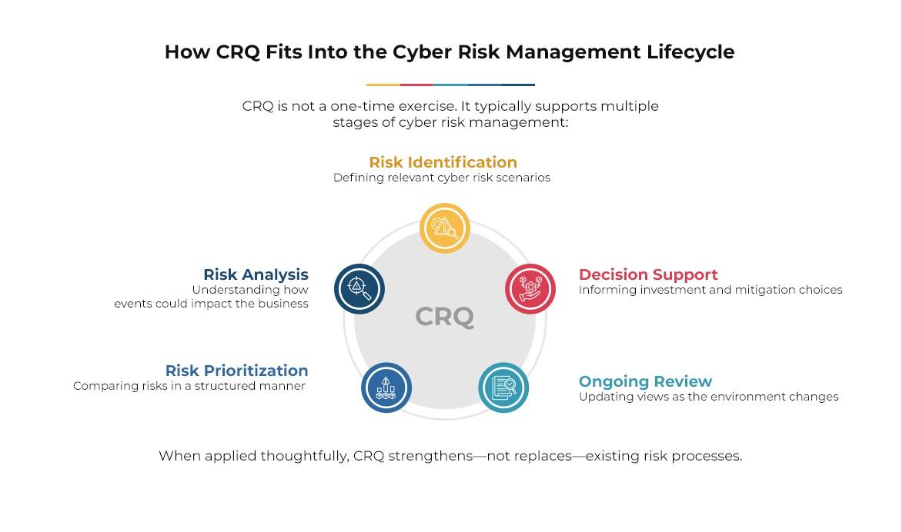
By continuously evaluating risk scenarios and business impact, CRQ encourages:
- Forward-looking risk thinking
- Early identification of emerging concerns
- More consistent risk discussions across teams
Common Misconceptions About CRQ
CRQ is not about predicting exact outcomes
It focuses on structured estimation and informed judgment, not certainty.
CRQ is not only for large enterprises
Any organization that needs clearer cyber risk decisions can benefit from CRQ principles.
CRQ is not a compliance shortcut
It complements compliance but does not replace regulatory requirements.
CRQ and the Role of Technology Platforms
Technology can support CRQ by:
- Structuring cyber risk scenarios
- Centralizing data inputs
- Enabling consistent reporting
Platforms like Quantara AI focus on enabling organizations to view cyber risk through a business and decision-oriented lens, while allowing teams to apply their own governance and judgment.
Key Takeaways
- Cyber Risk Quantification helps translate cyber risk into business-relevant insights
- It improves clarity, prioritization, and leadership communication
- CRQ strengthens cyber risk management without overpromising outcomes
- Its value lies in better decisions, not absolute predictions
Final Thought
Cyber risk management is no longer just a technical function—it is a business responsibility. CRQ plays an important role in helping organizations understand, communicate, and manage cyber risk with clarity and context.